A
lphonse Vassallo
new
2/16/99
I met Alphonse through a mutual friend, Don Isaac. We were visiting our
daughter in San Francisco, and took that opportunity to call Don and arrange a
visit. He in turn contacted Alphonse and Jim Symanski, and arranged for a visit
with them. Alphonse drove down from San Francisco, bringing three of his
Stirling engines. all three were original designs, and beautiful examples of the
machinists craft.
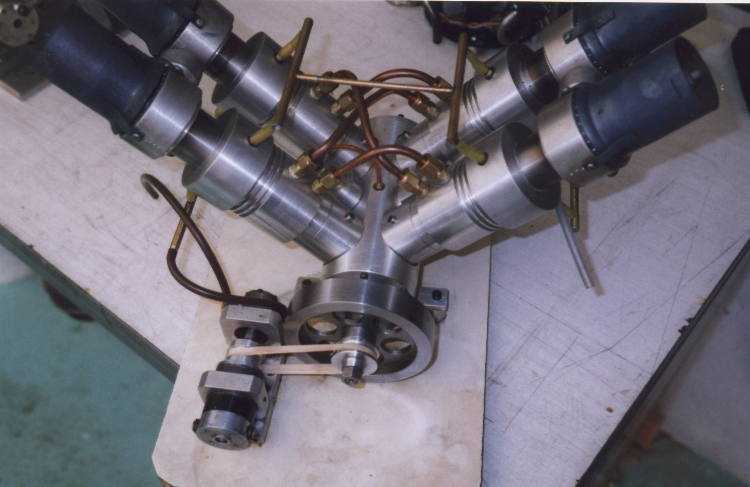
 The first to run was a V-4.
Alphonse connected the propane,
opened the valve, and then began hunting for the lighter! Don and I were
convinced that he was about to incenerate his truck, but he got it lighted
without causing any great conflagration. And how it ran! The V arrangement made
for a well balanced engine, and it must have achieved a top speed of well over 1000
rpm!
The first to run was a V-4.
Alphonse connected the propane,
opened the valve, and then began hunting for the lighter! Don and I were
convinced that he was about to incenerate his truck, but he got it lighted
without causing any great conflagration. And how it ran! The V arrangement made
for a well balanced engine, and it must have achieved a top speed of well over 1000
rpm!
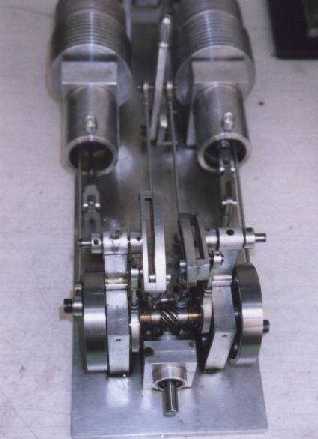
 The second engine was a two cylinder parallel marine engine with reversing
gear. The output shaft is coupled to the two flywheels through helical gearing,
and the reversing arcs (much like the valve gear segments on locomotives) were
operated by eccentrics on the engine shafts. Although there is quite a lot of
linkage involved, Alphonse's skill in fabrication yielded a low friction drive
arrangement. Unfortunately, the burner coupling did not match the one for the
V-4, so we could not run this engine. Don tells me that it, too, runs quite
well, and very silently.
The second engine was a two cylinder parallel marine engine with reversing
gear. The output shaft is coupled to the two flywheels through helical gearing,
and the reversing arcs (much like the valve gear segments on locomotives) were
operated by eccentrics on the engine shafts. Although there is quite a lot of
linkage involved, Alphonse's skill in fabrication yielded a low friction drive
arrangement. Unfortunately, the burner coupling did not match the one for the
V-4, so we could not run this engine. Don tells me that it, too, runs quite
well, and very silently.
Alphonse is from Malta, and has a brother who still lives there. Both
Vassallo brothers are not only expert machinists, but also creative designers.
Both have built a number of Stirling, steam and gasoline powered engines.
Although we are primarily interested in Stirling and other externally fired
engines, we find Alphonse's other engines equally as well made as his Stirlings.
We saw these a few days later when we visited Alphonse at his home in the
southern part of San Francisco. His home is a Typical San Francisco house, with
garage on the street level and the living quarters above. Alphonse greeted me at
the garage door, and immediately showed me to his shop in the rear part of the
garage. His shop equipment is simple, a Bridgeport mill and a 13" lathe.
But the work he turns out is far from simple, as you will see below. In addition
to his modeling, Alphonse has two patents to his credit, and while employed as
the machine shop foreman for Schlage Lock in San Francisco, developed a number
of tools and machines for fabricating lock parts.
After a short visit
in the shop, we went out on to the rear patio where Alphonse had arranged a
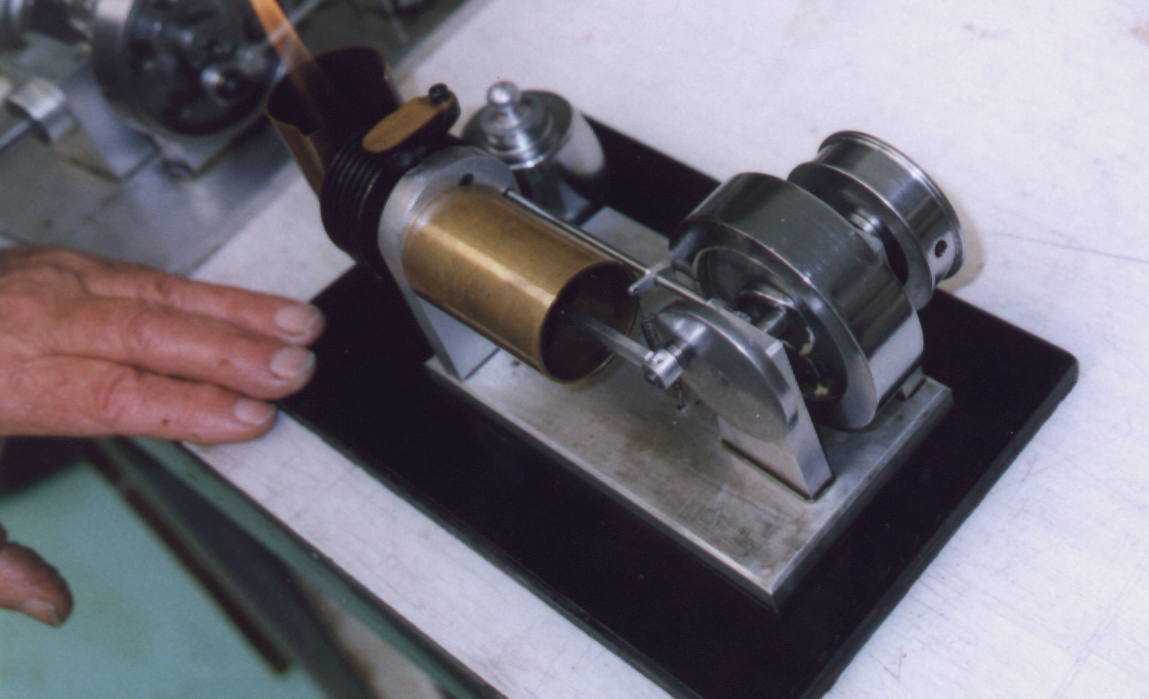
selection of his engines. One of the first he showed was a small flame licker,
which he said he built over 40 years ago. Despite its advanced age ;-), it ran
beautifully. Click on either of the pictures below for a larger view.
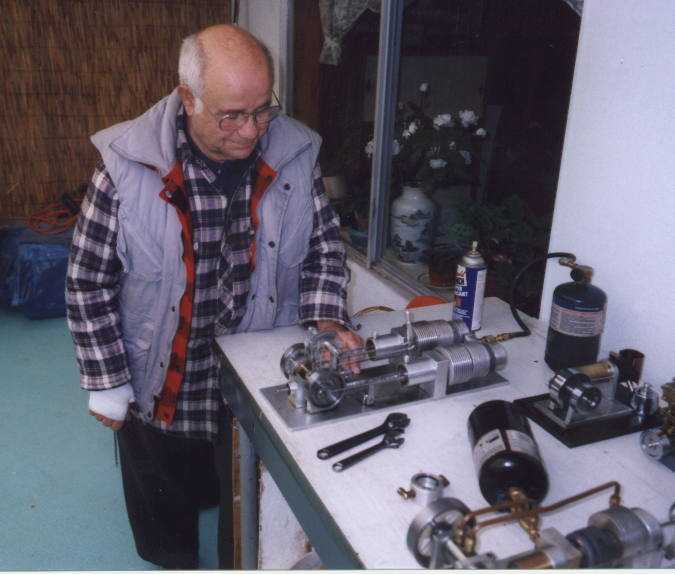
His 4 cylinder V-type engine was in evidence, as was the 2 cylinder marine
engine. This time, we had propane and it ran - just as silently as don Isaac had
said. Here are two more views of it, the first with Alphonse in attendance, and
the second which I hope will show more of the fine detailing of this engine.
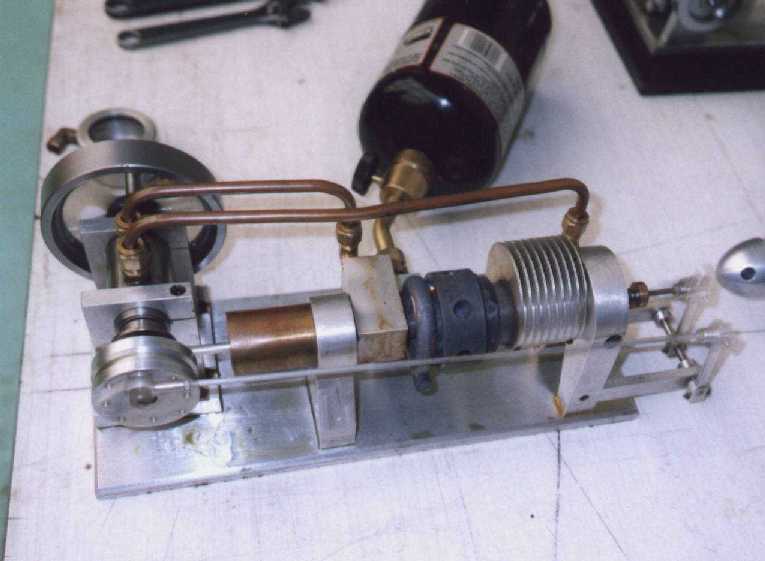
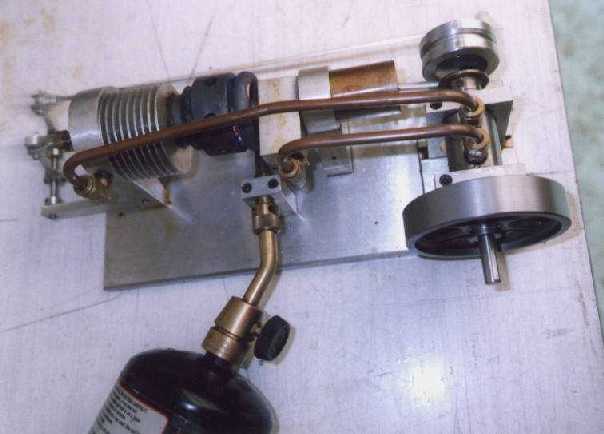
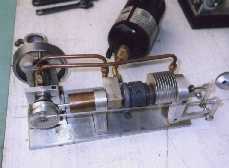
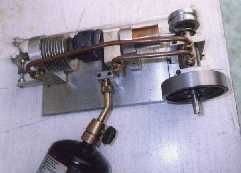
The most unusual Stirling engine that Alphonse has designed, is a
"backward" engine. The hot end is in the middle! And to get proper air
flow, Alphonse designed in a reed valve between the hot cylinder and the power
cylinder, and a rotary valve between the power cylinder and the cold end.
Referring to the photo on the left below, the reed valve is in the square box
just to the left of the ring burner, while the rotary valve is between the left
end crank disk and the flywheel. I have dubbed this engine "The Silent
One" because it indeed runs silently! As always, a click on the photo will
bring up an enlarged version for those of you who wish to see greater detail.
 |
 |
 |
A
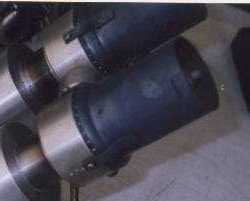
common thread on the Stirling engines you have seen on this page is the propane
burners, also a Vassallo design. Referring back to the V-4, they are just below
the flared shrouds, as illustrated here. You can also see one in the left hand
photo above. I hope that in the future we can get more details and possibly
plans for similar burners from Alphonse
|
The final Stirling that Alphonse showed me was the solar Stirling. using an
altazimuth mount and an 18 inch reflector, it runs on a minimal amount of
sumlight. The day I visited Alphonse was a typical San Francisco day, with fog
early in the morning, giving way to high clouds later on. Alphonse was not sure
there was enough sun to run the engine, but with a little clearing, the engine
came up to a respectable speed in just a few minutes. So here you see yet
another example of fine craftsmanship and design.
TO BE CONTINUED NEXT WEEK...
CHECK BACK TO SEE ALPHONSE'S INTERNAL
COMBUSTION ENGINES, AND THE SURPRIZE ENDING!
 The first to run was a V-4.
Alphonse connected the propane,
opened the valve, and then began hunting for the lighter! Don and I were
convinced that he was about to incenerate his truck, but he got it lighted
without causing any great conflagration. And how it ran! The V arrangement made
for a well balanced engine, and it must have achieved a top speed of well over 1000
rpm!
The first to run was a V-4.
Alphonse connected the propane,
opened the valve, and then began hunting for the lighter! Don and I were
convinced that he was about to incenerate his truck, but he got it lighted
without causing any great conflagration. And how it ran! The V arrangement made
for a well balanced engine, and it must have achieved a top speed of well over 1000
rpm!